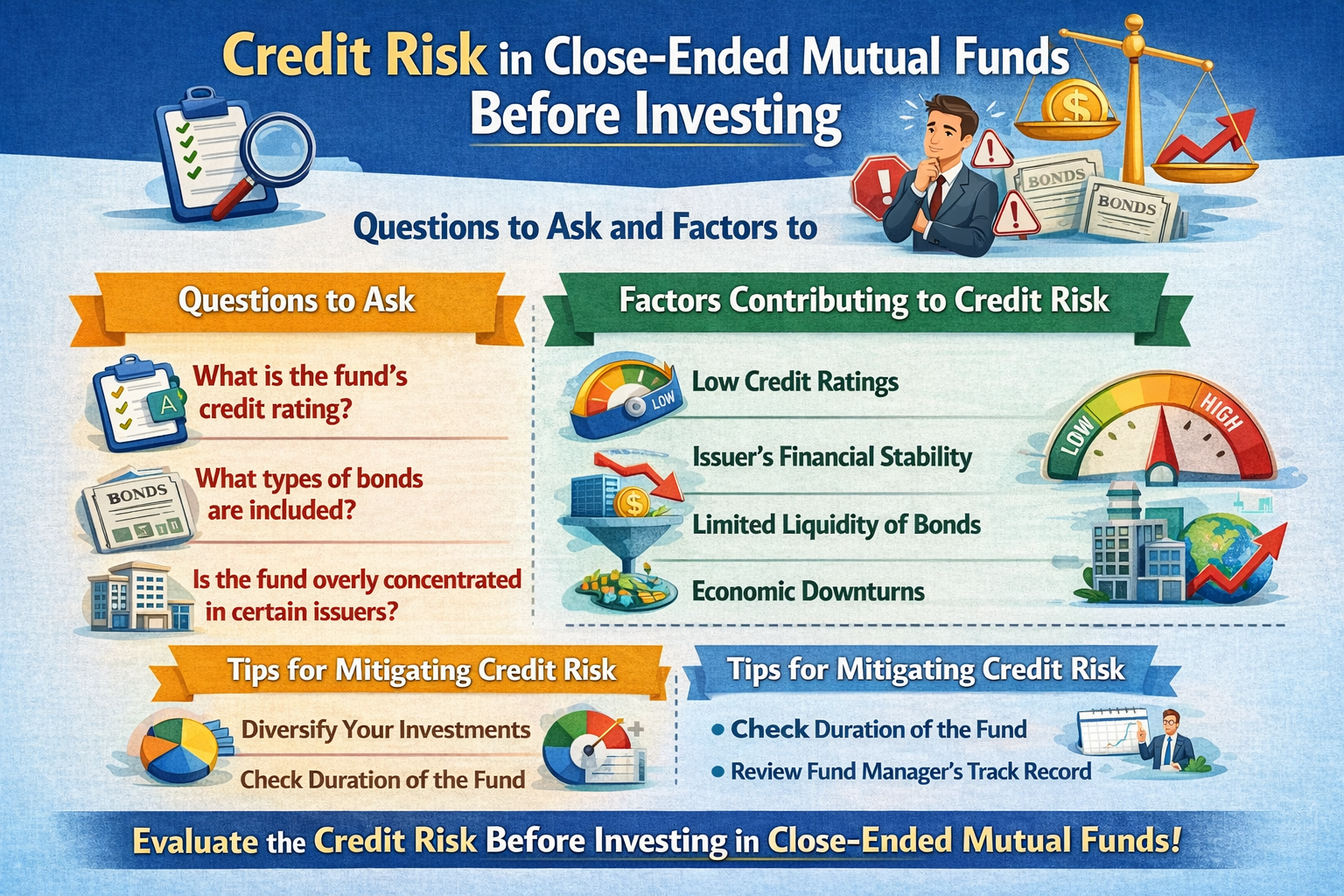
How to Evaluate Credit Risk in Close-Ended Mutual Funds Before Investing
Investing in close-ended mutual funds can be an attractive opportunity for individuals seeking exposure to various financial instruments while aiming to maximize returns. However, evaluating the credit risk associated with such funds is crucial before making an investment decision. Credit risk is the possibility that the issuer of a debt instrument (such as bonds or debentures held by the mutual fund) fails to meet obligations like principal repayment or periodic interest payments. Understanding this risk is essential to safeguard your investment from potential defaults and ensure prudent portfolio management.
In this article, we delve into the factors influencing credit risk, the methodology to assess it in the context of close-ended mutual funds, and how investors can make informed decisions.
What is Credit Risk in Close-Ended Mutual Funds?
Close-ended mutual funds are investment vehicles with a defined maturity period and fixed number of shares, traded on stock exchanges. These funds generally invest in a mix of instruments, including equities, corporate bonds, government securities, and money market instruments.
The credit risk in close-ended mutual funds primarily stems from exposure to debt instruments (bonds). If a fund holds bonds issued by entities with poor creditworthiness, the likelihood of defaults increases, which directly impacts the fund’s Net Asset Value (NAV). Therefore, assessing credit risk becomes pivotal in evaluating the fund’s stability and potential long-term performance.
Factors That Influence Credit Risk in Close-Ended Funds
1. Credit Ratings of Instruments:
Credit ratings assigned by agencies like CRISIL, CARE Ratings, and ICRA provide valuable insights into the creditworthiness of issuers. Instruments rated AAA or AA are considered lower-risk, while those rated BBB or below exhibit higher credit risk. It is essential to review the portfolio composition of the fund for instruments with favorable credit ratings.
2. Issuer Profile:
A detailed analysis of the entities issuing the bonds held by the fund is necessary. For instance, government-backed securities and bonds from financially stable companies involve lower credit risk than those from weaker issuers with signs of financial distress.
3. Sector Exposure:
Certain sectors, like infrastructure or real estate, might carry higher credit risk due to their susceptibility to external factors and economic volatility. On the other hand, sectors like FMCGs (Fast-Moving Consumer Goods) may carry relatively low credit risk due to consistent cash flows.
4. Interest Rate Fluctuations:
Rising interest rates generally increase credit risk for low-rated and high-yield bondholders. As borrowing costs rise, entities with fragile financial health may struggle to service debt obligations, leading to possible defaults.
5. Economic Conditions:
Macro-economic factors play a critical role in assessing credit risk. During periods of economic instability or recession, the probability of corporate defaults increases, impacting debt instruments within mutual funds.
How to Evaluate Credit Risk in Close-Ended Mutual Funds
To assess the credit risk, investors should follow a systematic approach:
1. Analyze the Fund’s Fact Sheet:
The fact sheet provides essential details about the fund, including its portfolio holdings, asset allocation, credit ratings, and sectoral exposure. Carefully scrutinize debt instruments within the fund to identify vulnerability to potential defaults.
2. Review Historical Performance:
Past performance often reflects the fund managers’ ability to mitigate credit risk effectively. A fund with a stable or positive historical NAV trajectory may indicate prudent credit risk management.
3. Consider Net Asset Value (NAV) Trends:
The fluctuations in the NAV over time can highlight a fund’s exposure to credit risk. Consistent dips in the NAV may hint at underlying issues with bond defaults or unfavorable economic conditions.
4. Calculate the Portfolio Risk:
Investors can calculate the weighted average credit risk by multiplying the credit risk (probability of default rating or PD) of individual securities with their respective portfolio weights.
Example:
Suppose a close-ended mutual fund has three bonds in its portfolio:
– Bond A (AAA rating, PD = 0.01%) with a weight of 50%.
– Bond B (AA rating, PD = 0.05%) with a weight of 30%.
– Bond C (BBB rating, PD = 1%) with a weight of 20%.
Weighted average credit risk:
Weighted Risk = (0.01 × 50%) + (0.05 × 30%) + (1 × 20%)
= 0.005% + 0.015% + 0.2%
= 0.22%
A calculated credit risk of 0.22% suggests relatively low vulnerability to defaults. Investors can replicate this calculation to assess a fund’s portfolio.
5. Financial Health of Issuers:
Review the balance sheet, profit-and-loss statements, and cash flow analysis of the issuers behind the bonds held by the fund. Indicators such as high debt-to-equity ratios and declining revenue show increased credit risk.
6. Leverage Credit Spreads:
The difference between yields of corporate bonds vs government bonds serves as a measure of credit risk. Wider credit spreads typically indicate higher risk.
7. Study Market Sentiments:
Investor sentiment around the fund and credit instruments can offer qualitative insights. A fund experiencing withdrawals or reduced market activity may reflect concerns about its credit exposure.
Key Considerations Before Investing
While evaluating credit risk is an integral step, investors must consider additional elements such as fund expenses, taxation, lock-in periods, and alignment with long-term financial goals. Understanding risk tolerance as an investor is critical to determine the suitability of a close-ended mutual fund.
Disclaimer:
The content provided above is purely for informational purposes and should not be considered financial advice. Investors must evaluate the risks, rewards, and overall suitability of funds for their portfolios. Trading in the Indian financial market involves inherent risks, and it’s recommended to seek professional consultancy or research thoroughly before making any investment.
Summary
Investors in close-ended mutual funds should assess credit risk, which represents the likelihood that bond issuers fail to meet their obligations. Crucial evaluation points include analyzing credit ratings, issuer profiles, sector exposure, NAV trends, historical performance, portfolio diversification, and economic conditions. Calculating weighted average credit risk using credit ratings and bond weightings can provide further clarity. A systematic risk assessment approach ensures safer investment choices.
With diligent analysis, investors can discern funds with sound credit profiles and mitigate potential threats to their financial growth. However, considering the risks associated with the financial market, a detailed evaluation of fund parameters and professional advice is advisable to make informed decisions.